I was going to write this after a week, but my desire to be kind overcame my desire to spill my guts. One of the most valuable things I've realized over the years is that writing angry is simply a bad idea. In overcoming my anger and frustration I chose silence until I could accurately come to grips with my feelings about my diabetes technology. I was more concerned about being nice than voicing my unhappiness, which is a horrible thing as a consumer (and blogger). So here are my thoughts as unfiltered as possible. Scroll down to the bottom for a brief recap.
I forgot how much picking a pump is like buying a car. You have these perceptions and this belief in what you'll get: sometimes it's better and sometimes it's worse. You never know until you drop into the driver's sear for a while. Fun fact that I learned: Medtronic Minimed (MM) has a 30 Day Return Policy. It's not advertised anywhere but they will tell you if you ask. If they really want to continue testing out their device, they will offer to extend that to 60 or 90 days. Honestly, I wish the 60 or 90 days was standard because how can you really know whether the system isn't for you or if you just need to become more comfortable with using it? More on how I knew for sure later.
After one week, I wrote this: "I've been waxing and waning between excited and apprehensive. So far, the Minimed 530g has me running Barenaked Ladies lyrics through my head, but the pump should be singing to me, including the the anger and frustration to the mutual apologies." I stopped there. I may have gotten a little stuck in the symbolism.
The first Enlite sensor I put in with the Minimed trainer was surprisingly comfortable. The insertion was easy-peasy. Loading the sensor into the insertion device was adult-insecurity-proof. Hold it flat against your stomach. In the sensor goes straight down at 90 degrees after on button press. Press and hold to pull the inserter off. So simple you could do it with one hand - I found that gimmicky. Seriously, when am I going to do this one handed especially considering the cost and lifetime of a single sensor. Using two hands is not the end of the world. Pulling the needle out and having it retract into it's personal housing was a spring-loaded cool and painless. Medtronic gets my props for designing that.
One of my old gripes about MM's previous CGM sensor was that the little seashell transmitter never stayed still. The eventually started selling seashell-shaped backing tape individual of the sensors but I hadn't stuck around long enough for that. The Enlite comes with backing automatically attached to the portion under the transmitter. That along with a special overtape (to go over the sensor but not over the transmitter unless you want a second piece) helped everything stay in place. Add one more short piece of tape to hold the seashell down and the sensor was pretty secure (wayyy more than the old one). The trainer told me that all the adhesive that MM selected was pressure sensitive so holding it down for 5 or 10 seconds would help the sensor stay on longer. Of the fours sensors I've worn, only one came off early and honestly that may be my own fault for getting caught on a door way (really, who's surprised).
I was happily surprised to see that charging the transmitter wasn't as big of a deal as I made it sound in the last post. Not eight hours. More like 30 minutes between each 6 days of wear. I only spaced on that once (with the sensor that came out early) where charging the transmitter slowed me down from running out the door, but I managed to keep myself busy with other things in the meanwhile. I imagine that taking a sensor out and putting the transmitter on the charger becomes second nature after you've been wearing it long enough so no reason to fuss.
After the initial sensor placement, there's a 2 hour warm-up period after which you put in a calibration (same as Dex). For a Dexcom, you actually need to put in two readings after the warm up and I usually do two immediately (aka I use the same value twice - shocking I know). For the Enlite, you need to enter another calibration within 6 hours. You should only put in one calibration in every 30 minutes. You must calibrate once every 12 hours or the Enlite sensor stops providing data. The way that the MM algorithm works is based on weighting the last four calibrations in order to translate from ISF to blood glucose. So if one of those calibrations is sub-optimal, then your accuracy is off until you get rid of the bad value in your log. None of this weighting nonsense exists with the Dexcom G4 system.
One of the big claims that I kept hearing over and over again is that you can calibrate the sensor whenever you want, with few exceptions. DEFINITELY a sales gimmick. For the previous MM sensor, you could only calibrate at times when your blood sugar is stable. I NEVER understood this. If I knew my blood sugar was stable, why would I be using your device? There are a ton of unreasonable assumptions: your blood sugar is stable when you wake up, when you go to bed, and before meals. Is it true for a lot of people? Sure. Does it work for me? No way. When I get up is the only real guaranteed stable point in 24 hours. After that, I'm running around like a madwoman, eating bits and pieces of healthy and unhealthy crumbs all day long, with nothing that resembles a schedule between two adjacent days. I'm in graduate school and everyone knows that college-life is not a steady well scheduled thing. I will eat ice cream before I go to bed. I will snack through my two-hour post prandials.
Different people will tell you different things. One rep told me it was okay to calibrate with one arrow. One told me never. A technical rep told me not to calibrate when I saw the sensor and meter values were far apart even when my blood sugar was stable at a high or low number. I could only calibrate when I was within a happy range. Another technical rep told me that I needed to get up and get my body moving to get my interstitial fluid (ISF) moving when that happened (to which I asked, I REALLY have to get our of bed in the middle of the night to stretch???). Coming from a Dexcom where you can ACTUALLY put in a blood sugar whenever you want, I couldn't handle this only calibrating during "stable" times especially since accurate calibration is what seriously affects sensor accuracy.
Another thing that is a little bizarre to me is the insistence that I use the Next Link Meter. Supposedly, this Bayer baby has better accuracy than other meters. I didn't notice a difference between it and my one touch mini the few times I did double fingerstick experiments. The 530g system was FDA approved with the meter, even though you can't bolus with it just transmit fingerstick values. No real complaints about the meter. The case is weird. The strips are a little harder to insert. I found myself looking down to see that the new strip hadn't registered even thought I had already splashed blood over. It is kind of nifty though that you can add blood afterwards if the sample is too small.
This accuracy issue goes right to the Low Glucose Suspend (LGS). I actually like how the LGS is designed and demonstrated. Basically, the pump turns off for 2 hours if your blood sugar is low. If you don't respond it basal insulin stays suspended and the alarm keeps hollering. There's a nice message on the display that says something along the lines of I'm a diabetic and I need help. Great for non-responsive situations. If you are responsive, you can chose to suspend the basal insulin for two hours to resume the basal activity. Let me say this again: I LOVE that this feature exists. I LOVE how simple it is to use. I LOVE the way it was designed. However, I cannot stand it when combined with bad sensor accuracy.
Every time (4 times total) I put in a new sensor I had the same problem: surprise LGS in the middle of the night when my blood sugar was fine. I verified that with finger sticks twice. I assumed the other two with good reason (::cough cough:: my Dexcom). The first time, the low alarms and LGS just kept me awake all night. The second time, the LGS went off and I slept through it, I never got the high alarm because the sensor was out of range, and I woke up high at 250ish. The third time, the LGS went off and and I slept through it, I got the high alarm as I woke up saying 186 mg/dl when my meter was saying 290ish. The fourth time, I kept getting low blood sugar and weak signal alarms, and I didn't get any sleep.
Accuracy when compared to my Dexcom was reasonable after 48 hours. Those first 48 hours ranged from atrocious to mildly irritating though. The Enlite sensor did much better on day six than day one. The Dexcom G4 sensors take about 12 to 18 hours before being a trustworthy accurate for me. However, their warm up period never quite reaches mildly irritating because I can always pop in a calibration ans see semi-immediate alterations in the blood glucose calculations. Also, an awkward comparison since the G4 sensors are good for seven days.
This brings me to my last few gripes. Sensor range. The range of a MM sensor should exceed my body. Getting a weak signal alarm when the sensor is in my left hand pocket of my jeans when my transmitter is on the right side of my stomach is asinine. There's no better way to say it. I shouldn't be getting weak signal alerts or lost sensor alerts when I'm in my bed. This is 2013. We can transmit things across countries. Bluetooth works at greater range. What kind of low grade tech are you putting into the transmitter that prevents this? Oh right, you didn't upgrade the transmitters. Just the sensors...
Alarm volume? Comparable to the Dexcom. However, I can amplify the Dexcom alarms in a low tech way (glass with coins next to my bed). I cannot sleep with my pump next to my head, because of the weak signal problems. My sheets and comforter muffled the alarms so much that I had no idea a LGS was going off til I peeled them down. Not cool. The vibration isn't all that strong either. I've had a whole lot of phantom pump alerts trying to keep an eye out for them.
Battery life? Well I guess you can say this was low because of the number of alarms. But really? 2 weeks before my first battery change is kind of sad, but I don't really know how to compare it since my Dexcom is only checking my sugar...
After the fourth sensor (and the 10th or so night of not sleeping), I decided to stick a fork in my diabetes tech experiment and ask for a return. You can't tell me I can calibrate whenever I want and then tell me I'm calibrating at inappropriate times. I also did not enjoy being treated like a child when I said it wasn't for me. I don't think medical devices should be a hard sell. My trainer put me on the verge of tears because they blamed my D-control was the problem when I blamed sensor accuracy and they almost had me believing it, which is super uncool with a condition that comes with as much of a mental burden as a physical one. I did break down on the phone with the continuing care representative a little bit. I all out bawled afterwards out of exhaustion, frustration, and high blood sugar. That said, all in all the customer service was much better than I was expecting. Lots of follow up. I know that they are people too. They get judged on who stays and who goes. I'm sure the everyone's under pressure with this new system.
So now, MM is processing the return. Two weeks minimum before everything is sorted out from the device end. No idea on how long refunding the insurance claim will take. I'm crossing my fingers that it won't be longer than mid-December so that I don't have to pay through the nose for a new pump and a new transmitter for my Dexcom because of deductibles (ironically the battery on that died this Sunday before I decided to return the MM system). What am I getting next? Still keeping my options open and doing way more research before I take the plunge again...
TL;DR
Pros :-)
Ease of sensor insertion
Adhesion of the sensor
One device
Low glucose suspend
Mehs :-|
Transmitter charging
Battery consumption
NextLink Meter
Cons :-(
CALIBRATION!!!
Sensor accuracy (and therefore low glucose suspend)
Alarm volume
Transmission range
My recommendation: Only use the system if you're comfortable with MM's CGM tech already. Otherwise Dexcom rules.
If there's anything I didn't discuss and you're curious about, leave me a comment!
Showing posts with label Supplies. Show all posts
Showing posts with label Supplies. Show all posts
Thursday, November 21, 2013

Tuesday, January 24, 2012
Not Coordinated or Together (or a Good Example)
I don't pretend to be a good example. Or a maker of good decisions.
Most days, I carry around a massive black backpack. One filled with my laptop and folders for school and all the fun diabetes supplies I carry around. In addition to my little tupperware case of medical swag and glucometer, you can usually find a big bottle of glucose tabs, Clif bars, a Nalgene water bottle, and an emergency Diet Coke can (because you never know when you'll need caffeine).
For a variety of reasons, I've been experimenting with downsizing. Instead of bringing my laptop with me (which is the main reason for the humongous backpack), I managed to bring two folders, my d-tupperware, a snack, a tube of glucose tabs, my tester, and my water bottle on the very first day of classes this semester. But I've been going back and forth between my big black backpack and my slim blue tote.
Monday was a crazy (read: super unprepared) mad rush to school. I *almost* forgot about my weekly seminar. I stuck my folders in my tote with my tester, d-case, and a fast snack, and then, I dashed to my car. As soon as I pulled out my notebook during the seminar, I realized I forgot a pen (not a girl scout without my big prepared bad with 9 of everything). No biggie. Just borrowed one from a friend. During my 20 minute break between the two classes, I quickly ran up to the lab to straighten out a meeting I had missed cause of the seminar. Checked Eggster to see a nice flat line around 90. No worries...
Until the ominous triple buzz set in 5 minutes into my second class. And Eggy says? 64 mg/dl. No prob. Just need some sugar. But since I grabbed the slim tote, no sugar in site. Just mozerella sticks and carrots. Instead of saying something or just taking a few minutes to hunt down some sugar, I sat there. I suspended my pump. Devoured those cheese sticks as discretely as I could. Kept pressing the button on my Eggy to prevent the LOW screeching. As soon as class was over, I ran to my car an chomped down on four glucose tabs...
But I had to hurry for my first gym class of the semester (or ever...). My roommates and I signed up for this flexible exercise series at the school gym. I want more structure (read: an external motivator) in my sweatabetes. And I'm always willing to try something new. So I needed to dart to the gym for my very first Zumba class. Still low though. And it's raining. But I'm very functional. The gym is only a 1 minute away by car. 10 minutes later. Still low. More glucose tabs. Run in and change. Still low. Find the room. Only at 68 according to Eggy. But I'm exercising anyway.
I know it's not healthy. But I wasn't doing this for my diabetes. I was doing this for me. Because if I skipped number 1, I'd skip the next one. And the next one. I don't want to sit on the sidelines. And a little low isn't going to stop me. At some point the glucose tabs kicked in. My pump was still on suspend and I turned it back on once I was past 100 mg/dl. I peaked at 130 and then slowly came down with the exercise. The rest of the night was filled with little glasses of juice. But I survived.
I spent over an hour in a hypoglycemic state (under 70 mg/dl according to Eggy) and an hour in in severe hypoglycemic state (under 55 mg/dl according to Eggy). And I'm lucky nothing happened. But now, I'm taping a tube of glucose tabs into every bag I own for next time.
(By the by, I'm not coordinated. But I survived Zumba. Kept up pretty well and only screwed up a fourth of the moves...I think. Someone needs to teach me how to pick up my feet instead of planting them. Oh and need new sneakers. STAT! The only thing that hurt when I was done was my ego and my feet.)
Wednesday, January 18, 2012
So Much to Carry
Having diabetes inadvertently means carrying TONS of extra stuff around all the time or suffer some rather unpleasant consequences.
I started experimenting with different sites more. Travelling on the fly more. Paying more attention to my good friend, Diabetes. Having more bad experiences without extra supplies. Whatever the reason, I realized how important it was to carry more than just a glucose monitor with me.
So now, I try to carry:
- Glucose meter
- Lancing device
- Test Strips
- Continuous Glucose Monitor Reciever (Eggy!)
- 2 pump reservoirs
- 2 infusion sets
- An Extra Bottle of Strips
- 1 AAA battery
- Current Vial of Insulin (and an extra if it's looking low)
- A bajillion alcohol swabs (that I don't realllly use except for site changes [shhh!])
- A tube of glucose tabs (or a bottle if it's a bad day/big bag)
- Glucagon (usually there's one case in my backpack but I can't say it wanders out to dinner with me all the time...)
Now that I'm older, I have purchasing power. I COULD buy whatever I wanted to hold this in. Coach. Nine West. Dolce & Gabana. (Alright, I'm kidding. If you know me, you know I'm no where near that trendy). In reality, I'm an eternal college student. I'm also really picky when it comes to bags and shoes. I like simple. Sleek. Elegant. The green army pack was never going to make it. But sometimes, my engineering side kicks in. So instead of buying a bag, I just macguyvered things around the house.
My favorite thing to carry supplies in is a tupperware container. Nothing fancy. Or blue. I ordered takeout sushi one night and the plastic container in was just the right size to fit all I needed. Plus, it's super easy to swap from my backpack to my purse to my overnight bag/carry on without losing any essential pieces. And the vain side of me loves that it's black instead of that ugly white plastic. If you were feeling crafty (or sticker-y), you could easily paint or wrap that clear cover to look cooler.
Large tupperware container filled with pump supplies!

On the inside of the large container

I was talking via Twitter to Mr. Mike Lawson (who's really cool if you didn't know) and he was wondering about something more manly and sleek to carry d-supplies around in. Since he's on multiple daily injections (MDI), there's a little less gear to tote around in some ways. I was thinking of other things to stick supplies in just in case tupperware isn't your thing.
The best thing I found around my apartment was my hard shell sunglasses case. I can't really remember where I got it from but it's pretty easy to stuff in the essentials (testing supplies, insulin, and syringes). There's tons of hard shell cases online and in stores and most are less than $30.
Sunglass Case, Small Takeout Container, Large Takeout Container

Small Container with MDI Supplies

Sunglass Case with MDI Supplies
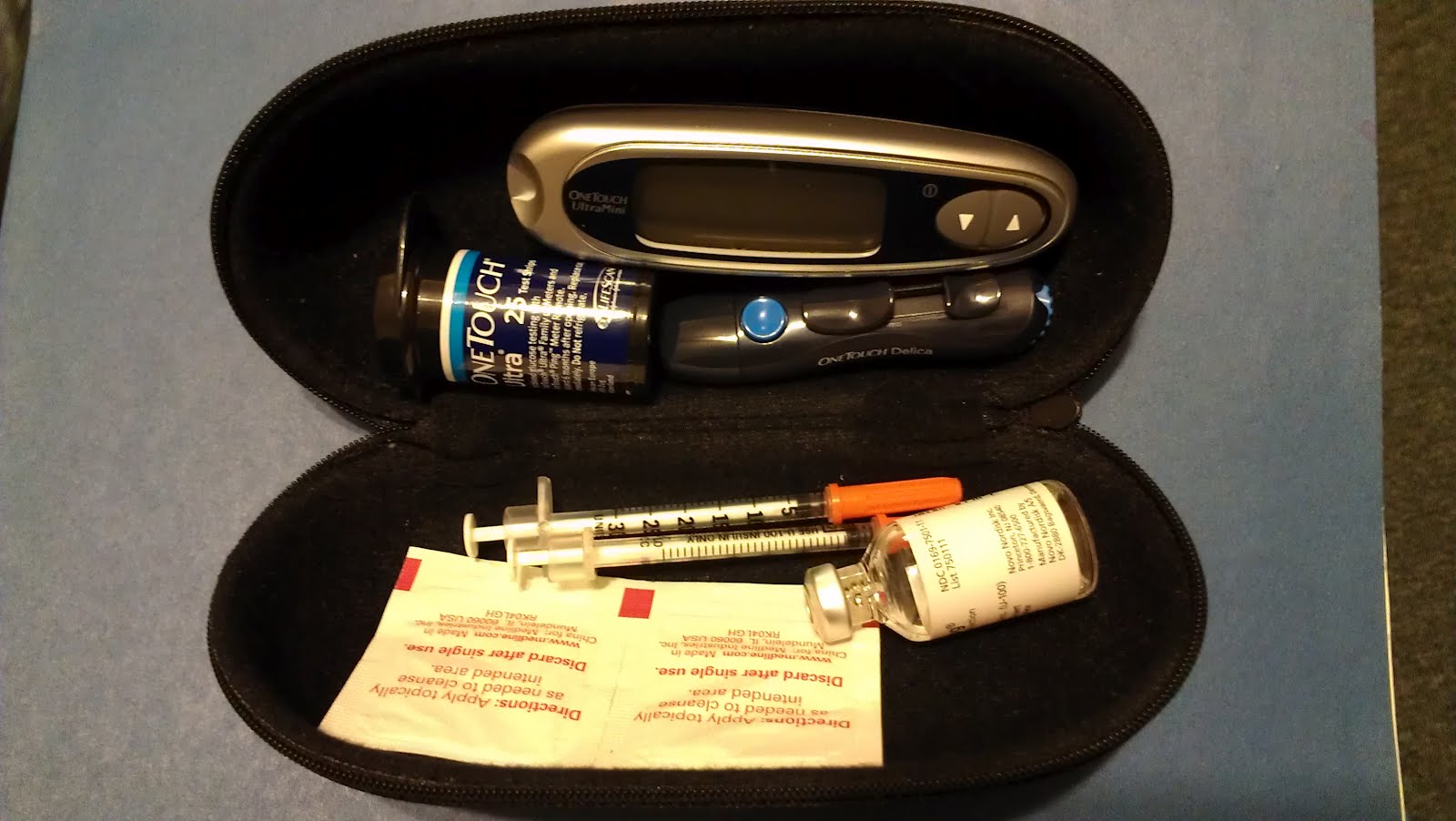
Playing around with different things, I think the size of the case is most important and the limiting factor is really the size of your meter. Most syringes and vials of insulin are the same size. But really if your meter is big, your case needs to be large enough to hold it. A OneTouch Mini is pretty tiny but the only meter I had at the moment to test with. Also, I recommend any makeshift case be water proof/resistant, sturdy, and easy to clean. If making/modifying carrying cases isn't your thing, there are tons of cute or manly carrying cases out there to buy nowadays. Some even come with built in slots to hold syringes and vials! We'll see how long it takes me to graduate from tupperware...
Subscribe to:
Posts (Atom)